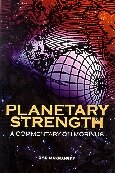
This is a commentary on Morin's Book 18 (immediately above), on Planetary Strengths, which is why I placed it here. Computation of planetary strength enables you to rank planets in a chart by their overall strengths. Morin divides this into three sections: Celestial, which is to say, by sign; Terrestrial, which is by house; and Aspectual, which is by aspect. Regrettably, unlike the planetary strengths as given in Lilly, CC Zain, Doris Chase Doan, Ken Stone & Morin himself, Makransky gives no actual numbers. Note this well, as this distinguishes Makransky from all the others.
This book will advance your study of astrology by giving you new avenues for investigation. For that reason you should get it.
But I am personally unhappy with it. Makransky has overlaid a great deal of ideology. His, not Morin's.
Strong planets, Makransky says, are better than weak ones. Well, no. They're not. Strong planets are, in fact, different. Different signs provide different means of expression.
Strong planets give us free will, he says (pg. vii). In fact, all planets give free will, regardless of their strength.
Weak planets show helplessness & vulnerability (pg. viii), but not according to any chart I ever read.
A weak, afflicted natal planet will never bring fulfillment in your life even if it is nominally a benefic. (pg. viii) Regret that I have examples that show exactly the opposite.
Planets that are dignified are spirited. Planets that are debilitated are non-plussed (pg. 3), which the dictionary defines as confused or unperturbed, which is to say, passive. Well, again, no.
On the other hand, when all planets are peregrine [ie, not good or bad, not strong or weak - Dave], what is indicated is nonchalance: you are relaxed, slow-paced, but rather desultory in your interests, lacking in real gusto for life. But because you have few axes to grind, you manage to get along quite well with all sorts of people. (pg. 4)
- Which is an astonishing reading of a chart, if you stop to think about it. Popularity means you're mediocre. Moving along, Makransky tabulates the effects of five good planets vs: five bad planets, four good vs: four bad, three good vs: three bad. Here are the results of five baddies:
On the other hand, a preponderance of planets essentially debilitated (five or more in detriment and fall) indicates that you are self-conscious, nervous, and wary. Albeit sociable & outgoing, you are super-sensitive, easily hurt, and take things very much to heart. You shrink from reproach and placate or temporize whenever possible. You feel a strong need to be looked up to, and usually try to play the good fellow. You tend to be shy or awkward, but are genuinely unassuming and friendly. (pg. 6)
Sometimes when I quote material I only quote a fragment, enough to give you a flavor. This time I quoted the entire section. When we think about it, of ten bodies in a chart, having five of them messed up would seem to be quite rare. Such people, so one would imagine, would almost certainly never amount to anything & would thereby pass completely unnoticed. Do you not agree?
Ladies and gentlemen, I give you Mr. Hitler, born April 20, 1889, in Brannau, Austria. Correct his birth time to give him a Scorpio rising (6.54 pm LMT) - or don't correct it, it won't change Makransky's analysis. Here are Mr. Hitler's debilities:
- Moon in Capricorn, its debility
- Venus retrograde, the most serious of all its debilities - and,
- conjunct debilitated Mars in Taurus
- Jupiter in Capricorn, debilitated
- Saturn in Leo, debilitated
That's five debilitated planets. Exactly what part of Makransky's fantasy delineation fits? Adolf Hitler was passive? Popular? Well, yes, he was that, provided you were German. If Adolf Hitler wasn't the single most powerful man of the 20th century, then he's tied with Chairman Mao. It was by sheer fantastic good fortune - and the bloody sacrifice of millions - that he came to a bad end.
In Chapter 1, on Celestial State, there are delineations, Good state & Bad, for each of the planets. These are essentially unlabeled delineations for the signs the planets rule, vs: the unlabeled signs of their debilities. Thus, Mercury in bad celestial state is adamant (pg. 9). Such as, I dunno, Mercury in Pisces. In a bad celestial state, such as Pisces, or so I presume, You have strong opinions and you take them & yourself very seriously . . . with something of a siege mentality. You often feel isolated, misjudged, in need of a little appreciation for your efforts. . . (pg. 9) Or maybe he's thinking of Sagittarius. Yes! That must be it.
In chapter 2, on house position/strength, we learn that angular planets (in houses 1, 4, 7, & 10) find social relationships stimulating, while planets in succedent houses (2, 5, 8, 11) find social relationships challenging, and planets in cadent houses (3, 6, 9, 12) find social relationships overwhelming (pg. 18). This is not only a crude view of houses, it's unacceptably misleading. The delineations, for angular and cadent placements only, ignores the affinity that Jupiter and Mercury have for cadent houses, as these planets rule the mutable signs, which relate directly to the cadent houses.
On pg. 30 we learn that planets conjunct the ascendant indicate casual relationships; conjunct the descendant, close relationships; conjunct the MC, group relationships; and conjunct the IC, solitude. We therefore have the explanation for the popularity of George W. Bush, recent president of the United States, who had Mercury conjunct the angle of casual relationships and Jupiter conjunct solitude (July 6, 1946, 7.26 am EDT, New Haven, CT). Dear George, with your empty 10th house, how did you become leader of us all?
In Chapter 3, Aspectual State, we learn the difference between well-aspected & well-afflicted chart natives is that the former live strategically, go with the flow, and as a result people tend to accept them on their own terms, whereas the latter stumble and bumble and struggle against the flow, and as a result the tend to be rejected by people. Well-aspected actions are detached whereas afflicted actions are malajusted (emphasis in original, pg. 42) So, presumably, badly aspected charts should be more likely to end up in jail? Which I imagine some of them do, but on the other hand, bad aspects are the fire that gets people going & makes them amount to something. Grand trines, as Carter and many others have noted, are notorious for producing indolence. I have a sister with a staggering grand trine/kite totalling eight planets (January 24, 1965). This chapter, while no better than the first two, is a bit murkier, since the definition of "well-aspected" and "well-afflicted" has never quite been settled.
Makransky's chart is on pg. 44: August 1, 1947, 1:09:50 pm EDT, Philadelphia. Here is part of how he describes himself:
For example, in my own chart Neptune is quite well-aspected, since it is the point planet of a wedge mediating an opposition between Moon & Sun-Saturn-Pluto, and indeed psychedelic drug and plant experiences have always been most beneficial to my spiritual growth and happiness. Moreover, I continually receive valuable guidance and information talking to spirits and trees. . . Contrariwise, I've noticed that people with an afflicted Neptune probably shouldn't mess around with drugs, and they tend to get involved with the wrong sorts of spirits; money tends to flow easily to people with a well-aspected Jupiter. (pg. 45-6)
(I'm wondering how Jupiter & money got tacked onto a sentence about Neptune and drugs.)
Makransky's abilities with drugs & spirits, good or bad, is not the issue. I could be small-minded and say, Avoid them both, they're BAD FOR YOU !!!, but that's not for me to say. What I can say is that drugs and spirits remove you from the physical world, they lift your feet off the ground & make you less able to deal with every day realities. That's their function. People take drugs to find new realities, or to escape an unhappy physical reality, it's all about the same. Since taking birth & having a physical life is about experiencing physical reality and everything that goes with it, good and bad, happy and sad, using drugs to remove oneself from it is to deny the reason for one's very existence. Which is what I said before, about not having your feet on the ground.
So, I regret to say, this is one mess of a book. And, sorry to say, the underlying problem is becoming clear. Margaret, at Wessex, doesn't know a good book from a bad one.
Wessex Astrologer, 138 pages.

 Jean-Baptiste Morin (or Morinus), a native of Villefranche, France, lived from 1583 to 1656, which makes him a generation senior to England's William Lilly. Morin was a physician with training in astronomy. He began to study astrology in the 1620's & quickly acquired a reputation in the French court. He held the post of Royal Professor of Mathematics from 1630 until his death. In his capacity as court astrologer to Louis XIII, he was present at the birth of Louis XIV (the Sun King) in 1638.
 Indicates a book on our Top Ten list. If you would like to find more books like it, click on the star.