The Astrology Center of America, 207 Victory Lane, Bel Air, MD 21014
Tel: 410-638-7761; Toll-free (orders only): 800-475-2272
Home Author Index Title Index Subject Index Vedic Books Tarot E-Mail: Dave


Astrology and Psychology: Counseling Astrology, page 2


Counseling Astrology: Page 1 Page 2 Page 3

See also: Liz Green, Howard Sasportas & Friends
and: Donna Cunningham


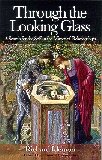
THROUGH THE LOOKING GLASS: A search for the self in the mirror of relationships - Richard Idemon, $31.00

Contents:

Preface by the trustees of the Richard Idemon Trust
Foreword, by Liz Greene
Editor's note, by Howard Sasportas
Introduction

Part 1: The basics of relating:
Your personal mythology, basic ground & hidden agendas
The moon: naming your inner child
The parent-child relationship: breaking the psychological umbilical cord
Lunar aspects: what you need to feel nurtured

Part 2: Realizing the self:
Eros & projection in adult relationships
What is this thing called love?
Mars: self-assertion in relationship

Part 3: Practical applications of synastry:
Relationship significators in the natal chart
Relationship significators in the chart of Isadora Duncan
The art of synastry: comparing the charts of Zelda & F. Scott Fitzgerald
Group discussion & conclusion

Comment:

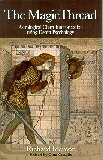
Richard Idemon lived to the age of 49, from 1938 to 1987. He died of AIDS. He was the principal teacher of Donna Cunningham, when they were both in New York in the 1970's. He subsequently moved to San Francisco, where excessive use of amyl and/or butyl nitrate most likely killed him, as it killed a lot of men at about that time. (Use of those two drugs has since been sharply curtailed.) While in San Francisco he studied Jung, which, one way or another, brought him to the attention of Liz Greene's Centre for Psychological Astrology, in London. There are two books attributed to him, both originally published by Samuel Weiser, in Maine, both consisting of lectures transcribed posthumously. This one, Through the Looking Glass, was edited by Howard Sasportas, who himself died in 1992, aged 44. The other is The Magic Thread. Both of these have now been reprinted by Margaret Cahill at Wessex Astrologer, in Bournemouth, UK. Margaret thinks like I think: A bookstore is just a bookstore, but a bookstore that also publishes is a lot better, in good times & bad. And as it's bad times at the moment, Margaret is eagerly printing books that she likes. As am I. I think we are fortunate that two stores, one in England, one in the US, have both figured this out, and that they have such very different tastes in the many books they print. Makes for better selection. But I digress.

Books like this are strange to me. On the back it says, In this book, Richard Idemon teaches us how to look at the natal chart to gain rich, new insights into our deepest nature so that we can gain greater understanding of our 'personal mythology' - the hidden agendas, childhood patterns, and the belief systems . . . & etc. (A poorly constructed sentence, by the way.)

We open the book & find it to be about relationships. Which, for most of us, is about whatever we can get away with without overmuch troubling ourselves. So let's start at the beginning, with Part 1, Your Personal Mythology.

The first sentence in the first paragraph of the first chapter of the book declares, My main topic today is the parent-child relationship. . . but then immediately starts to wander. In part this is because this is a transcription of a lecture & the speaker felt like wandering. In the first ten lines he wanders to Einstein, and then to Newton & apples, and then, a few lines further, back to Einstein. On the second page he brings up myth. Bottom of the second page, what people would think of Joan of Arc if she were alive today (a kook, clearly, but remember that Joan was an enemy of the English). Top of the third page, an old friend snubs another by accident. All of which, by the bottom of the page, are examples of mythology & mythologizing. "Mythologizing" the Free Dictionary (on-line) defines as constructing myths, or interpreting or writing about myths. Since that wasn't very clear, I looked up the word myth itself to find it was, 1. A traditional, typically ancient story dealing with supernatural beings, or, 2. A popular belief or story, or, 3. A fiction or half-truth, or, 4. A fictitious story, person, or thing. I see that these definitions are of two sorts: One refers to generally accepted beliefs, the other relates to privately invented lies, for lack of a better word. So I would deduce that if we apply privately imagined fictions to our personal selves, the result would be delusion. No? Where did I go wrong, then?

But we're still in the first chapter & we're still attempting to construct Our Own Personal Mythology, because that's the title of the chapter we're reading. Bottom of the third page of text (which is numbered 5), Richard says, The point I am making is that every person carries around their own system of myths, and that every person's reality is founded and based on their mythical system. In Sociology, which Richard didn't study (I only studied a little, and long ago), there are names for this, and they're not so hot. Idemon then says that you can't discover one's individual myth from the natal chart. Which is pretty much a cliff-hanger, since we're Astrologers & we study charts, so I presume he's going to resolve this.

But first Richard defines myth. There are collective myths, like that of Adam & Eve, or Jason & the Argonauts. There are social myths, which is to say, my school is better than your school (Richard flubs it slightly), and then there are family myths. Which I suppose explains families that feud with each other (Hatfields & McCoys, etc.): Competing mythologies that got out of control. Idemon says the combination of collective, social & family myths are your very own personal myths. Which makes Richard an only child, methinks. I have four brothers & four sisters & we sure as heck don't all have the same personal myths, and, yes, I'll spare you my details if you'll spare me yours.

Still in the first chapter, Richard goes for the astrology. Richard says that a woman with Sun conjunct Mars conjunct Jupiter in Aries in the first house will have one sort of life if she was born in America, and a very different sort of life if she was born in a Chinese commune, where, according to Richard, she would be a peasant. I know something about this, as I have Jupiter in Aries, but Mars in Scorpio. In the year of my birth, by the time Mars got to Aries, Jupiter was in Taurus. Which makes a Sun-Mars-Jupiter conjunction in Aries a rare event. Just how rare? It wasn't 1916. It wasn't 1928. It wasn't 1940. It wasn't 1952. It wasn't 1963. It wasn't 1976. It wasn't 1987, the year of Richard Idemon's passing. It wasn't 1999. It wasn't 2010. Which is as far as I have printed ephemerides handy.

It was 1904, March 27th. (Were there communes before Mao & the Communists?) Jupiter & the Sun conjuncted at 6 Aries, while Mars was at 22 Aries. Hey! Close is for horseshoes. Aren't you glad that Mr. Idemon used an example from real life? If the lecture in this book dates from, say, 1985 (it's not dated, and the book was first published in 1992, posthumously), that woman was by then 81 years old. If she was, in fact, Chinese, she had quite an eventful life. (Makes me wanna read Pearl Buck's The Good Earth, but I digress.)

Idemon is by this time slowly settling down to business. On page 9 he tells us of a chat he once had with his brother, about their mother, and how the two of them saw her in a completely different light. Which he explains as two contrasting mythical views. Which means that not only was Richard not an only child, but that his theory, that one's personal myth is based on factors larger than oneself, is contradicted by his own experience, because if two brothers cannot agree on the mythical conception of their own mother, then what myth can they agree on? Remember: It's a myth if more than one person believes it. It's a private opinion if it's only you. Which I think is a good guideline.

I regret this is about as far as I want to go in this book. It's a ramble. If you like rambles, then this is for you. Most people are better speakers than writers, so that when they pass away, they are immediately lost. My apologies to Donna.

Wessex Astrologer, 284 pages.


Read the book? Want to tell the world? How many stars (1-5) would you give this book? Tell us!


ASTROLOGY TRANSFORMATION & EMPOWERMENT - Adrian Ross Duncan, $29.95

Contents:

List of illustrations
Acknowledgements
Foreword, by Erin Sullivan

Part 1: Setting the scene:
Introduction: The philosophical foundation of the counseling practice
1. Making contact - creating the unified field with your client
2. Communication - getting to your client's core issues
3. Evoking inner resources - empowering your client

Part 2: The major players - planetary combinations
Introduction: The inner & outer planets
4. The Sun - existential challenges
5. The Moon - cradle of the unconscious
6. Mercury - making connections
7. Venus - bonding
8. Mars - warrior & lover
9. Jupiter through Pluto - the collective framework

Part 3: Transformatioin methods
Introduction: Astrology that works
10. First impressions - winning the client's confidence
11. Awareness of the problem - and seeing it in a new way
12. Reframing - an empowering intervention
13. Memory - Helping clients recall core material
14. Past, present, future - challenging with the time continuum
15. Deeper intervention techniques
16. Other intervention techniques - secret therapy, metaphor, and direct feedback
17. Synastric consultations
18. Points to remember

Appendix: Meditation on the four elements

Notes
Bibliography
Index

Comment: On the back of the book, it says this:

Astrology: Transformation & Empowerment is dedicated wholly to the practice of counseling astrology. Going far beyond using astrology as a diagnostic tool, this comprehensive work shows how to harness perception and sensory states to create positive change by reading horoscopes and astutely observing the client. By accessing the basic energy patterns that form identity and inform behavior, reality can be transformed for the best.

Adrian Ross Duncan, a pioneer with over fifteen years experience practicing counseling astrology, deftly shows how to empower clients and create transformation by harnessing horoscopes. Concisely written & amply detailed, Astrology: Transformation & Empowerment carries the counseling astrologer and his or her clients to begin positive change in only one session! Duncan shares case studies and includes over 40 planetary charts and figures to guide the user. Part One, "Setting the Scene," explains how to read clients' body language and tone of voice prior to reading their charts. "The Major Players," Part Two, depicts specific planetary combinations and how they relate to emotional response, relationships, and the future. And Part Three, "Transformation Methods," further teaches ways to expand awareness of the challenges at hand, reframe the reading, expand sensory skills, and discover new communications systems.

There's some nice stuff in this book. The author's method of interrogating his prisoners, I mean clients, is revealing. Since it's probably unique to him, I was curious about his chart. He publishes his wheel on his website, but without date, nor time, nor degrees. It works out to about 11 am in York, England, on Sunday, July 17, 1949. (I could get it to the minute, but I would only be showing off.) He says he's quite normal except for his Sun on the Uranus/Pluto midpoint, and Uranus culminating. I would add his Neptune/Moon opposition (1 to 7) and the Venus/Pluto conjunction in the 11th. What he has written is not a book for beginners, but will amply reward the experienced.

Weiser, 314 pages.


THE ASTROLOGY OF SELF-DISCOVERY - Tracy Marks, $18.95

Contents:

Introduction

Part 1: The Moon & its nodes
1. The Moon: reparenting the inner child
2. Moon signs
3. New Moon, full Moon
4. The lunar nodes: our life's purpose

Part 2: The outer planet transits
5. Transits: The next step in our becoming
6. Neptune: How to swim through cosmic waters
7. Pluto: From darkness into light

Part 3: Astrology & self-development
8. Principles of depth astrology
9. Misuses of astrology
10. Beyond fate & free will

Conclusion

Appendix: Eclipse & lunation tables by zodiacal degree, 1960-1995, and, as a supplement, 1996-2015
Selected bibliography
About the author

Comment: This book was first published in 1985 & has now been revised & updated. I regret I do not have a copy of the original edition, so I cannot tell you what has been changed. In the Introduction, the author says chapter 10, Beyond Fate & Free Will, is new to this edition. In the Introduction, on pg. 1, she writes:

The ideas presented in this book are an integration of depth psychology (including psychosynthesis, gestalt therapy, Jungian psychology and object relations), spiritual teachings and traditional astrology, with learnings derived from my own professisonal work, psychotherapy, and self-therapy through my adult life. I draw from my own experience, intuition, and the knowledge gained through study, inner work, and in-depth interactions with other people.
So we should have a good book here. The early chapters sound a lot like the mid-1980's. Among other things, in the 1980's there was interest in scientific evidence that supported astrological principles (the Gauquelin books, among others), which we see in this book. I was curious about her notes on new & full Moons, as well as eclipses, as Tracy was born on a full Moon (Sun Libra, Moon Aries), roughly twelve hours after a lunar eclipse. I myself was born on a full moon, Sun Aquarius, Moon Leo, six hours before a lunar eclipse. I was expecting personal remarks on these factors. She had none. I was disappointed. Tracy discusses lunations & eclipses only as transiting factors.

Much of the book is written like this:

A Transiting Double Whammy
Occasionally, we will experience a transiting double whammy, such as transiting Pluto squaring our natal Saturn while transiting Saturn is squaring our natal Pluto. Such a combined transit is telling us that we must integrate the influences of Saturn & Pluto in terms of both their natal & transiting placements. We might do this by totally involving ourselves in our work or Saturnian commitments or by clearly putting an end to a situation related in meaning to one of the houses influenced by Saturn and Pluto, and by allowing ourselves to fully experience the "death" of one phase of our lives. (pg. 132)
Which, to me, just doesn't say anything. But let's move on. Let's skip ahead to the final chapter, on Fate.
When I was in my 20's & 30's, and writing the earlier edition of this book, I believed - or wanted to believe - that if we attuned ourselves to the most constructive expression of a transit, we would cooperate with planetary cycles and minimize the negative influences. To some extent, I still believe that this is true - or at least believe that conscious listening to and focusing upon the highest potentials of a planetary combination will serve us. But I do now acknowledge that at times, no matter how deeply we meditate, set our intentions, and make active constructive choices, we may sometimes be creamed, blasted into bits, leveled, discombobulated, flattened, tormented, and flagellated by life circumstances.

WHY? Why do bad things happen to good people? .... (pg. 285)

On the very last page of the book, Tracy gives enough of her chart data that construction is not a problem. So I did that. What happened to Tracy? First, March, 1995, Pluto went stationary directly over her Mars. (To the minute. Ouch!) Then, in 2007, Pluto made three passes over her ascendant. That will sober anyone.

I made an interesting discovery about my full Moon over the summer, I will pass it along to Ms Marks. Full Moon people have a "black box" aspect about their lives. Things that are one way, solar, perhaps, have a mysterious & unknown (ie opposition) way of turning into something quite different. And the reverse, from the lunar perspective. This is based on the house positions of the two luminaries, and can be used to rectify a chart where the Moon is exactly on the IC, as it is in Tracy's chart. If the "black box" obscures the relation between brilliant thoughts (Sun in 9) and everyday life (3rd house), then the Moon is in 3. If the "black box" obscures brilliant thoughts (9) and "where's my daddy?", then the Moon is in 4. Given Tracy's profession, I'd guess her Moon is in 4: Intellectual effort (9) to understand one's psychological origins (4).

Full Moons grant objectivity. This is inherent. There is You. There is Me. The full Moon sees both sides clearly. This is weak in Tracy's case as the two bodies are six degrees past opposition. Which, when one of them is the Moon, is a lot. The awareness of the objectivity comes by means of "helper planets", ie, planets that are in aspect to both. In Tracy's case, Mars is trine & sextile. It also disposes the Moon. Uranus is square.

And, no, Tracy, your moon is not heavily afflicted (pg. 192). It is opposite the Sun, which is not an affliction. It's opposed Neptune, which ought to be a good thing, as, with it, you can see the con man coming a mile away. It is trine Mars, which rules it, which is good. It is square Uranus, which isn't. A square aspect is defined as a relationship that ought to work, but doesn't, for reasons that are never quite clear: stress. One bad aspect does not make for serious affliction. Inconjuncts from Virgo (Mercury, Venus, Saturn) are not aspects, not unless you have a 3rd house Moon, which you do not.

Ibis/Nicholas Hays, 314 pages.


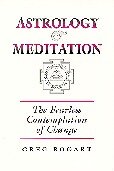
ASTROLOGY & MEDITATION, The fearless contemplation of change - Greg Bogart, $20.00
Contents: Acknowledgements; Quote from Dane Rudhyar;

1. Astrology, meditation & the fearless contemplation of change;

2. Astrological & planetary meditations: Sun, Moon, Mercury, Venus, Mars, Jupiter, Saturn, Uranus, Neptune, Pluto

3. The technique of symbol amplification in astrological counseling: Symbol amplification in dreams & birth chart interpretation, Symbol amplification through derived house analysis, Openness to multiple levels of meaning, Symbol amplification & chart rectification

4. Astrology as a spiritual practice: Strategically timed action, Conscious suffering, Astrological alchemy & the formative use of will, Detachment & commitment, Lessons of love, A final meditation.

Appendix A: The twelve yogas of the zodiac; Appendix B: Understanding the Jupiter-Saturn cycle; Footnotes.

Comment: Bogart is an accomplished meditator & mystic, but this is not a book about meditation. Bogart believes meditation to be as natural as falling asleep, and as sure-fire as sexual orgasm. Hence he offers no instruction.

Chapter 1 tells the story of a lawyer with transiting Pluto conjunct his 10th house Mars. The man's life was erupting into a non-stop brawl. A lesser astrologer said merely to endure it. Bogart got the man to meditate & in only weeks he had quit his job & went to work at an international human rights organization.

Chapter 2 is a look at difficult outer planet transits to the various natal planets, where the answer is generally to meditate upon, What is the highest outcome of this transit? (pg. 16) Bogart relates anecdotes from his practice, as well as his own personal experiences. Telepathy between blood relatives (his father & himself, pg. 49) seems to surprise him. He offers dream analysis.

Chapter 3, The Technique of Symbol Amplification, continues with multi-level dream analysis, pulling it back into multi-level analysis of transits to the natal chart.

Chapter 4 is how we can infuse spiritualized astrology into all our waking activities.

There are some 45 charts in the book. None of them are sourced, and none are complete. Bogart gives an empty wheel, and then places into the proper houses only the planets (natal & transit) he is dealing with. Degrees are never given, signs only rarely. This forces us to accept Bogart's analysis instead of making our own.

Wessex Astrologer, 142 pages.


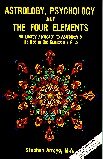
ASTROLOGY, PSYCHOLOGY & THE FOUR ELEMENTS: An Energy Approach to Astrology & Its Use in the Counseling Arts - Stephen Arroyo, $15.95
Contents: Prologue

Part 1: Astrology & Psychology:
1. Modern science & psychology today
2. The limitations of the old framework
3. Different approaches to knowledge & the question of proof
4. Archetypes & universal principles
5. Approaches to astrology
6. Humanistic psychology & humanistic astrology
7. The uses of astrology in the counseling arts
8. Notes on education & the training of astrological counselors

Part 2: The Four Elements: An Energy Approach to Interpreting Birth-charts:
9. Astrology: A language of energy: The zodiacal signs as energy patterns; The planets as energy regulators; The astrological theory of personality; Key concepts & definitions

10. The four elements: The basic energies of astrology: World-wide recognition of the elements; Modern descriptions; A spiritual perspective; Classification of elements; The element of fire; The element of air; The element of water; The element of earth

11. Psychology of the individual: The elements in the healing arts

12. Elements in interpretation: Imbalance of fire; Imbalance of earth; Imbalance of air; Imbalance of water; Self-expressive or self-repressive emphasis; Other element combinations

13. Potential for integration: Aspects & planetary relationships

14. Planets in the elements: Mercury; Venus; Mars; Sun, Moon & ascendant; Jupiter & Saturn; Other considerations

15. The elements in chart comparison

16. The elements & the houses: A key-word system: House classification; The water houses; The earth houses; The fire houses; The air houses; Astrology: A tool for self-knowledge

Appendices: A. Scientific data; B. Astrology & modern research in energy fields; C. Astrology & polarity theory; References to Part 1; Suggested readings

Comment: Part 1 of this book was originally written as a master's thesis in the department of Psychology at California State University in Sacramento. It essentially sums up the woeful state of the world & offers astrology as the logical solution.

Part 2 reduces astrology to the four elements. This is a rather limited view of astrology, with few of the details that give it life. In 1973, this book was awarded the Astrology Prize by the British Astrological Foundation.

CRCS, 186 pages, paper.


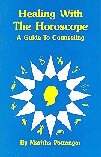
HEALING WITH THE HOROSCOPE, A Guide to Counseling - Maritha Pottenger, $14.95
Contents: Acknowledgements; Preface: Open letter to the reader; Foreword; Introduction: Therapy in 2050 (what kind of counselor are you?)

Section 1: Theory: 1. What is reality? 2. The question of meaning; 3. Theoretical model; 4. Information from other models of counseling; 5. Research on positive outcomes; 6. The reality of interpersonal relationships; 7. Who me? Projection; 8. Displacement & repression; 9. Responsibility & free will; 10. The issue of power; 11. Universal processes of counseling, step 1: establishing rapport; 12. Step 2: Gathering the evidence; 13. Step 3: Changing paradigms; 14. The importance of language; 15. Similarities of astrologers & other counselors; 16. Our expanding universe

Section 2: Applications: Preamble; 17. What is reality? 18. The question of meaning; 19. Theoretical model;

20. Negative effects: How will I know if I'm doing harm? A checklist; Possible astrological correlates of counsseling pitfalls; Checklist; Factors to avoid; Enjoying the world; Ethics; Sample contract; Post session questions

21. Positive outcomes: Examples of high, medium & low level empathy & respect; Examples of genuineness or congruence; Examples of concreteness; Empathy exercises; Genuineness exercises; Concreteness exercises; Successful counseling environment; A checklist

22. Projection: My favorite client; My least favorite client; Projection through the horoscope - abbreviated

23. Displacement & repression; 24. Responsibility & free will; 25. The issue of power; 26. Establishing rapport

27. Gathering evidence: Introduction; client checklist: What do I already know?; Checklist: When the client arrives; Notes on visual, auditory & kinesthetic types; Nonverbal exercises; Paying attention to client feedback: checklist; Generating hypotheses

28. Changing paradigms; 29. Putting it all together with cosmic glue

Section 3: Demonstration: 30. An example consultation.

Bibliography; Index.

Comment: One of her first books (1982). Compare to Donna Cunningham's Counseling Astrologer's Guidebook (sadly, out of print) for a contrasting view. Donna is more down to earth, Maritha is more academic in tone.

ACS, 240 pages, paper.


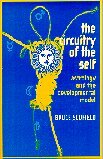
THE CIRCUITRY OF THE SELF: Astrology & the experimental model - Bruce Scofield, $12.95
Contents: Introduction: Comparing astrology with pyschology; Scientific model building

1. Where is the person in the astrological chart? The limits of psychology; The common sense of human nature; The multiple selves; Planets as a map of the self

2. The mapping of the self: Self, ego & personality; Identity, soul & psyche; The modern psychoanalytic map of the self; The biological perspective; Caveman consciousness; Temperament

3. Instincts, emotions & biological rhythms: Instincts & imprint vulnerability; Emotions & the biological imperative; Circadian cycles & lunar periodicities

4. The developmental model: Freud; Rudolf Steiner's developmental stages; Erik Erikson's Freudian extension; Piaget's developmental model of learning; Building on Piaget & Freud; Comparing developmental models; Timothy Leary & Robert Anton Wilson

5. Astrology & the developmental model: The role of the sun; Giving up the ego; The inner planets; An explanation for astrology; The outer planets; Other factors in the birth chart

6. The lunar bio-survival stage: The lunar world of babies; The moon in traditional astrology; Lunar imprinting; The lunar aspects

7. The Mars circuit of individual power & autonomy: The Mars imprint; Mars & other planets

8. The Mercury circuit: Learning & language: Piaget's theory of learning; Cycles of Mercury; Mercury & the other planets

9. The Venus socio-sexual circuit: The cycles of Venus; Love, sex, fashion & culture; The aspects of Venus

10. Jupiter & Saturn: Planets of socialization & culture: Socialization & enculturation; Jupiter contacts with other planets; Saturn contacts with other planets; Reaching maturity & adulthood

11. The outer planet higher octave circuits: Neptune, Pluto, Uranus; The Neptunian holistic circuit; Neptune & the other planetary circuits; The Plutonian power-generating circuit; Pluto & the other planetary circuits; The Uranian conceptual circuit; Uranus & the other planets; The 8th non-local consciousness generating circuit

12. Epilogue

References

Comment: Let Bruce have the first word, from page 6: "I have wanted to write this book since the early 1980's when I was first introduced to the 8-circuit model of consciousness proposed by Timothy Leary & Robert Anton Wilson. At that time, it was immediately obvious to me that their model had a structure that could accommodate much of what astrology was about...."

What is this circuitry? It would seem to be a reworking of the classic Ages of Man. The Ages divide human life into arbitrary periods & assign a planet to each. According to Scofield, the first two years of life are ruled by the Moon, the next two (the "terrible twos") by Mars, ages 4 to 7 by Mercury, then Mars, Jupiter, Saturn, Uranus, Neptune & Pluto. Towards the end of the series the exact number of years of life these planets rule gets fuzzy. The Saturn Age (or circuit) takes us only to adulthood, according to Scofield.

The classic Ages go like this (from De Vore, pg. 279): Moon to age 4, Mercury from 5 to 14, Venus from 15 to 22, then Sun, Mars, Jupiter & Saturn, ending at age 99. Where the traditional ages came from is a bit murky at the moment, but one of the surprising things we are learning from close study of ancient astrology, is that ideas like this often have a strong theoretical underpinnings. The planets that rule the traditional Ages are ordered by their apparent speed, as viewed from the earth, fastest to slowest.

In Scofield's defense, he has long had an interest in Cosmobiology & Uranian astrology. He is not as prejudiced against modern science as I am, nor does he seem to share my interest in traditional astrology. Each of our beliefs are based on our own life experiences, which, of course, are the culmination of lifetimes of experience.

One Reed, 191 pages.


PRACTICING THE COSMIC SCIENCE: Key Insights in Modern Astrology - Stephen Arroyo, $13.95
Contents: Prologue; Introduction

1. Astrology today & the astrological psychology of tomorrow
2. The purpose & profession of astrology
3. Counseling & astrology as a healing process
4. Setting up & structuring a practice: A discussion group
5. Ancient laws - Modern interpretation: The rebirth of simplicity
6. Key issues in astrology today: Summaries of small-group brainstorming sessions
7. Thirty years working with astrology
8. In conversation with Stephen Arroyo

Appendix: The media blackout on astrology.

Comment: This is a new edition of The Practice & Profession of Astrology. Eight essays (most transcriptions of speeches) on the status of astrology & astrologers in the late 20th century.

CRCS, 205 pages, paper.


&mdash

Counseling Astrology: Page 1 Page 2 Page 3

See also: Liz Green, Howard Sasportas & Friends
and: Donna Cunningham


The Astrology Center of America

207 Victory Lane, Bel Air, MD 21014
Tel: 410-638-7761; Toll-free (orders only): 800-475-2272

Home Author Index Title Index Subject Index Vedic Books Tarot E-Mail: Dave


Established 1993, The Astrology Center of America is owned & operated by David Roell.
This entire site (AstroAmerica.com) is copyright 1996, 1997, 1998, 1999, 2000 by William R. Roell.
All rights reserved.